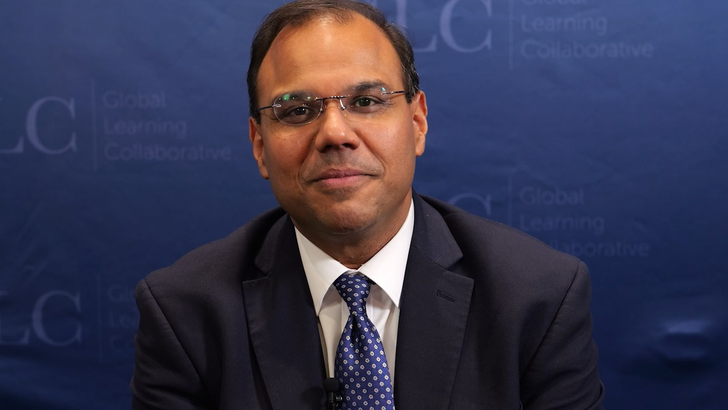
This video brief features Dr. Nihar Desai reporting from AHA 2025 in New Orleans. He evaluates the real-world evidence demonstrating the impact of evolocumab on major adverse cardiovascular events (MACE) in patients with established atherosclerotic cardiovascular disease (ASCVD). Dr. Desai reviews the study design and population and highlights how these findings complement prior randomized trial data. Tune in to find out how evolocumab may contribute to cardiovascular risk reduction in routine clinical practice for patients with ASCVD.
Real-World Impact of Evolocumab on MACE Reduction in ASCVD

Dr. Desai:
Hello from the American Heart Association Annual Scientific Sessions 2025 here in New Orleans. I'm Dr. Nihar Desai, associate professor of medicine and vice chief for the section of cardiovascular medicine at the Yale School of Medicine in New Haven, Connecticut.
I'm here to discuss important new real-world evidence examining evolocumab and its impact on major adverse cardiovascular events—or MACE—in patients with atherosclerotic cardiovascular disease.
By way of background, we all know that ASCVD is the leading cause of morbidity and mortality in the US and around the world. Multiple randomized trials have established the efficacy of evolocumab to lower LDL cholesterol and reduce the risk of MACE in patients with ASCVD. We then sought to evaluate the real-world effectiveness of evolocumab in reducing MACE outcomes in patients with ASCVD.
The study used the Komodo Healthcare Map and applied a target trial emulation framework and established comparative effectiveness framework. We included over 110,000 patients with ASCVD who were prescribed evolocumab, and then at day 75 after that initial prescription, divided the cohort based upon whether the patient continued evolocumab treatment—referred to as the treated cohort—or whether evolocumab treatment was discontinued—the non-treated cohort.
We then applied statistical modeling with inverse probability of treatment weighting to make the treated and non-treated groups as similar as possible along baseline characteristics. The groups were then followed forward, and we assessed the occurrence of composite MACE—myocardial infarction, stroke, or coronary revasc—the primary outcome, and cardiovascular death, myocardial infarction, and stroke as the secondary outcome, again both assessed at 4 years.
We found a 4.1% absolute risk reduction and a 20% relative reduction in the primary outcome, and a 4.2% absolute and 29% relative reduction in the secondary endpoint for those patients that were treated with evolocumab as compared to those that were non-treated.
I think the key conclusion from this real-world study of more than 110,000 patients, using a comparative effectiveness framework, demonstrated a significant clinical benefit with reduction in MACE events for patients treated with evolocumab as compared to those that were non-treated. Importantly, these data provide complementary evidence to those from traditional randomized trials and highlight the effectiveness of evolocumab in the real-world setting.
I think my take-home message from these data is that reducing LDL cholesterol remains the cornerstone for reducing adverse cardiovascular events among patients with atherosclerotic cardiovascular disease. These real-world data now show what we had seen and learned from prior randomized trials and really holds true in the real-world setting and again demonstrates the effectiveness of evolocumab in reducing cardiovascular risk in patients with atherosclerotic cardiovascular disease.
From the AHA Scientific Sessions in New Orleans, 2025, I'm Dr. Nihar Desai. Thank you so much for watching.
Ready to Claim Your Credits?
You have attempts to pass this post-test. Take your time and review carefully before submitting.
Good luck!
Overview
Provider(s)/Educational Partner(s)

Today’s healthcare environment is constantly evolving and advances of medical science occur at an accelerating pace. CME/CE plays an important role in the clinical environment and is an essential element of physician training, learning, and improvement, thereby importantly contributing to optimal patient care. Since 2000, MEDCON’s mission is to deliver high quality within the world of medical education by creating forums like PACE-CME, organizing live meetings, and providing online education. We aim to stimulate the review, exchange, and assimilation of key scientific findings to improve patients’ health, to raise awareness of new science underlying various disease states, and to accelerate the translation of this information into clinical practice.Commercial Support
This activity is supported by an independent educational grant from Amgen, Inc.
videoEvolocumab in Patients at High Cardiovascular Risk Without Prior MI or Stroke: Primary Results of the VESALIUS-CV Trial
Show more
videoGlobal Burden of Stroke and Myocardial Infarction in Patients at High Risk of First MACE: Insights From the VESALIUS-REAL Study
Show more
videoPrimary Results of the VESALIUS-CV Trial: Evolocumab in Patients at High Cardiovascular Risk Without Prior MI or Stroke
Show more
Overview
This video brief features Dr. Nihar Desai reporting from AHA 2025 in New Orleans. He evaluates the real-world evidence demonstrating the impact of evolocumab on major adverse cardiovascular events (MACE) in patients with established atherosclerotic cardiovascular disease (ASCVD). Dr. Desai reviews the study design and population and highlights how these findings complement prior randomized trial data. Tune in to find out how evolocumab may contribute to cardiovascular risk reduction in routine clinical practice for patients with ASCVD.
Provider(s)/Educational Partner(s)

Today’s healthcare environment is constantly evolving and advances of medical science occur at an accelerating pace. CME/CE plays an important role in the clinical environment and is an essential element of physician training, learning, and improvement, thereby importantly contributing to optimal patient care. Since 2000, MEDCON’s mission is to deliver high quality within the world of medical education by creating forums like PACE-CME, organizing live meetings, and providing online education. We aim to stimulate the review, exchange, and assimilation of key scientific findings to improve patients’ health, to raise awareness of new science underlying various disease states, and to accelerate the translation of this information into clinical practice.Commercial Support
This activity is supported by an independent educational grant from Amgen, Inc.
videoEvolocumab in Patients at High Cardiovascular Risk Without Prior MI or Stroke: Primary Results of the VESALIUS-CV Trial
Show more
videoGlobal Burden of Stroke and Myocardial Infarction in Patients at High Risk of First MACE: Insights From the VESALIUS-REAL Study
Show more
videoPrimary Results of the VESALIUS-CV Trial: Evolocumab in Patients at High Cardiovascular Risk Without Prior MI or Stroke
Show more
Title
Share on ReachMD
CloseProgram Chapters
Segment Chapters
Playlist:
Recommended
We’re glad to see you’re enjoying ReachMD…
but how about a more personalized experience?